Showing posts with label Greece. Show all posts

Thursday, September 3, 2015

Ancient Worlds Modern Beads Preview

We have just under a month until the official release date of Ancient Worlds Modern Beads– although some readers have received their copies already, and the response has been great so far! Thank you so much to everyone who has given the book a chance. It’s very exciting to know that readers will soon be able to learn the techniques and draw a little inspiration from my own favorite sources.

As promised, I’ve created a slideshow preview of every design featured. There are 30 projects in all – necklaces, bracelets, rings, and earrings all inspired by the ancient world. The video will give you chance to view all of the finished designs and some of the techniques covered in the book. I’ve only included the main designs – most projects also include examples of variations on color, materials, or style. In other words, there is a lot of jewelry squeezed into these pages!

For the most part, the projects are showcased in the video by the same order you'll find them in for each chapter of the book. Each civilization has its own section, with 10 projects for different skill levels - from beginner to advanced. In writing Ancient Worlds Modern Beads, I did my very best to provide the same attention to detail that Inspirational Beading readers have come to expect for both basic techniques and complete projects. Each chapter is also sprinkled with extra tips for getting the best results, creating variations, or finding the best materials for a design.


The inspirations are quite varied, though most projects are modelled after real ancient jewelry from Egypt, Greece, and Rome. Several pieces draw on the icons of ancient deities like Juno and Demeter, while others invoke the things we admire about the classical world. Many of my favorite designs are covered, including those that many Inspirational Beading readers have requested in the past such as the chevron collar, herringbone coil bracelet, and chevron lariat.

Nile Necklace from Ancient Worlds Modern Beads Necklace of Sithathoryunet - Met Museum

Nile Necklace Project

Amphora Cuff from Ancient Worlds Modern Beads Terracotta Lekythos - Met Museum

Amphora Cuff Project


Which project are you most interested in? Are there any techniques not covered that you’d like to see in a future tutorial or book? I would love to hear your thoughts!

Copyright 2015 Inspirational Beading
Barron's Educational Series and The Met Museum
Subscribe to Inspirational Beading
Get inspired on Facebook and Google+

Actions you take from this post can result in a commission for Inspirational Beading.


Tuesday, April 28, 2015

Introducing: Ancient Worlds Modern Beads

Ancient Worlds Modern Beads by Mortira Natasha vanPelt

The time has finally come to reveal the secret project that I’ve been working on for the past two years. There have been many bead teasers along the way, and I’ve dropped a few hints about the purpose behind the exciting designs that have passed through my workspace. At last I can say that it’s all been for the production of my first beading book: Ancient Worlds, Modern Beads.

I am very excited to present this collection of projects, all inspired by Ancient Egypt, Greece and Rome. Some of my all-time favorite designs are included with step-by-step instructions, along with oft-requested tutorials that will finally be available in full detail. There are lots of collars, bracelets, necklaces and rings to make using seed beads, glass, and natural beads. I’ve also bent my metal rules just a bit to include 4 earring projects that coordinate with many of the other pieces in the book. It was a tough decision to make, but ultimately I wanted to create the best selection of projects possible - and there were just too many great earring inspirations to pass up!

There are 30 projects in all – ten from each civilization. The projects are inspired by the culture, mythology, art and jewelry of the time. Many pieces recreate the look of actual ancient artifacts, while others capture an essence of each region and its legacy. The Egyptian projects were some of my favorites to create, of course. Greece and Rome offer up some pretty amazing inspirations of their own, and I can't wait to share them! It was incredibly fun to design each piece, and I hope that readers will love to recreate them as well. The book also includes some gorgeous handmade backgrounds, with textiles by Elaine Partington and glass by Matthew Durran.

Amarna Glass Earrings from The Met Amarna Beadwork Earrings from Ancient Worlds Modern Beads

Amarna Earring Project Inspired by Ancient Egyptian Relics


Ancient Worlds, Modern Beads will be published later this year by Barron's Educational Series. It is available now for pre-order from Indigo and Amazon.The official cover has not yet been revealed, and there are plenty of details still to come. I’m planning to release a full preview of all of the projects for you closer to release time. Meanwhile, I want to thank the creative team at Quarto for helping get this book off the ground, and for all of their hard work on bringing it together.

Roman Medallion Necklace from The Cleveland Museum of Art Juno Pendant from Ancient Worlds Modern Beads

Juno Pendant Project Inspired by Roman Medallion Jewelry


I also want to extend some very special thanks to every Inspirational Beading reader for your patience and support during these two hectic years. Being able to share my projects with you – if only as teasers – and reading your wonderful comments kept me going whenever I felt I couldn’t bead another stitch. Thank you for joining me here every week, and here’s to many more creative journeys!

Copyright 2015 Inspirational Beading and Friends
Subscribe to Inspirational Beading
Get inspired on Facebook and Google+

Following links to Amazon listings in this post may result in a commission for Inspirational Beading.


Tuesday, April 1, 2014

Bead Shops: O and N Craft Supplies

Greek Ceramic Beads from O and N Craft Supplies

One of the best ways to create designs that really stand out is to use materials that are unique and exciting. Today my guest is Tina, owner of O and N Craft Supplies - an amazing source of gorgeous beads and beading materials straight from Greece.

Inspirational Beading: How did you get into the business of jewelry supplies?

Tina: I’ve been making jewelry since I was a teenager and even have an Etsy jewelry shop. The world of jewelry supplies and craft supplies in general is a fascinating world for me, I can't have enough of them. When my husband and I became unemployed as a result of the economy crisis in Greece, we were trying to decide what could the next step be. We needed something we could both do. My knowledge of jewelry making and quality Greek craft products lead us to open our O and N Etsy shop and only a few days ago our own O and N site.

Inspirational Beading: In your opinion, what’s the best thing about small supplies shops vs. the big bead retailers?

Tina: We can serve our clients on a personal basis. We can help them find what they need and answer their questions more effectively.

Moreover a small shop is more likely to build a coherent style, a certain personality where clients go to shop because they want to cover specific needs. It is like shopping in a boutique shop rather than a department store.

Inspirational Beading: Do you have a favorite material, color, or bead style to keep in stock?

Tina: I love Greek ceramic beads especially the enameled, very shiny ones and our craft cords, braided silk cords and wrapped cotton cords are my favorite.

Craft Cords from O and N Craft Supplies Greek Ceramic Beads from O and N Craft Supplies


Inspirational Beading: What makes your bead selection stand out from other craft supplies shops?

Tina: Our ceramic beads are all made in Greece, as they were for thousands of years, of course adjusting to contemporary aesthetics. They have beautiful, vivid colors. They are often handformed and unglazed which gives them an earthy, handmade quality. Other times they have amazing, lustrous surfaces, more beautiful than pictures can show, as a result of multiple firings in the kiln, which makes them perfect for more luxurious, elegant projects. Another thing not to be neglected is that we can offer Greek ceramic beads in the best prices.

Inspirational Beading: Many beaders are familiar with the emotion that comes from selling a finished design. How does it feel when you sell something that will become a beautiful work of art?

Tina: I will be honest, nothing compares with the feeling when someone appreciates something you made! But often I picture our customers the moment when the first open their package, and ideas start popping in their head at the first sight of our jewelry supplies and it makes me smile.

Engraved Metals Beads from O and N Craft Supplies

Inspirational Beading: What is your favorite thing to make (or see others make) with your beads?

Tina: I like statement necklaces with multiple rows of cords of different textures and chunky ceramic beads.

Inspirational Beading: Do you have any plans for new products this year?

Tina: Our next step is to add Greek leather cord which is the best quality leather cord.

You can see more unique and colorful beads and craft supplies at O an N and on Etsy. To see the latest additions and specials, follow along on Facebook.

Copyright 2014 Inspirational Beading and O and N Craft Supplies
Subscribe to Inspirational Beading
Get inspired on Facebook and Google+


Thursday, September 1, 2011

World Beaders: Turkey

I was very excited when I noticed that Turkey was one of the top visitors to Inspirational Beading in August, and I couldn’t wait to start searching for some gorgeous bead and jewelry inspirations from this wonderfully exotic part of the world.

istanbul_beads

Bead-heaven


Turkey is one of the world’s oldest inhabited areas, and has been home to many cultures, including the Hittites, Hattians, Assyrians, Babylonians, and the Ancient Greeks. It is also the home of Ancient Troy, a city that has been considered real, legendary, and back again throughout history. Turkey’s largest city, Istanbul, was once the capital of the Roman Empire, under the name Constantinople, previously called Byzantium.

Beads and lamps of Turkey in Cappadocia

beads


Source: flickr.com via Iain on Pinterest


Due to it’s geographical location, Turkey features a variety of climates and ecosystems that make it the country with the highest variety of plant species in Europe. According to The Garden Lady, “Turkey has an extraordinary degree of biodiversity with almost as many species of wild flowers as the rest of Europe combined; of the over 9000 species so far identified more than 3000 are native to the country, many found nowhere else on earth…”.

Turkish Beads, Jewelry and Culture

1. Turkish beads,
2. Tumulus (Nemrut Dağı, Turkey), 3. istanbul, 4. Beads, 5. istanbul,
6. Turkish Jewels, 7. Jewelry,
8. Grand Bazaar- Istanbul, Turkey, 9. Beads, Yoruk Koyu,
10. Seeing Eye Beads of Istanbul, Turkey, 11. evil eye beads, 12. Woman selling beads in Turkey, 13. Beads


Like neighboring Greece, evil eye beads or nazar Boncugu are a common sight in Turkey. These beads are used to ward of the effects of envy and ill wishes, and feature a gorgeous eye design, usually in blue glass.

Happy beading, Turkey!

Copyright 2011 Inspirational Beading
Subscribe to Inspirational Beading
Get inspired on Facebook


Friday, August 26, 2011

Coordinating Complementary Colors

Walt Disney's Fantasia, The Pastoral Symphony

Do you know where your preferences for color come from? Do you embrace the colors of your past, or avoid them and explore new possibilities?

I started to think differently about color choices recently, when I was confronted with some old memories of the role complementary colors used to play in my artwork and crafts. I had borrowed a copy of Disney’s Fantasia from the library, and hoped that my bead helper would enjoy the movie as much as I did when I was young.

Watching it again, I was momentarily stunned by the memories it gave me of using color. I can clearly remember a running theme with almost anything I made, where I would create copies of the same design, and use different sets of color until all possibilities where exhausted. I kept up this habit until a few years ago, when I was making daisy chain friendship necklaces in all kinds of flower palettes - the classic white and yellow daisy, purple and yellow violets, and yellow and brown for Brown-eyed Susans, among others.

If I didn’t know any better, I would say that Fantasia had a lot to do with this trend, particularly The Pastoral Symphony chapter, or Beethoven’s Symphony No. 6. The mythical story that the creators paired with the symphony has romantic overtones, and throughout the scene, creatures in a variety of colors pair off together.

Walt Disney's Fantasia, The Pegasus Couple


The first example of this complementary color theme is the Pegasus family. The female is a traditional winged horse in white, and her eyes are blue. Her mate is midnight black. The animators could have given him eyes of any color, but they chose red, making him the exact opposite of the female. This use of opposites inspired the concept of pairing: make one bracelet in red and blue, and the next one in green and yellow.

The Centaurs inspired a slightly different way of using color. The combinations of skin, hair and coat colors created a desire to make copies of designs in as many palettes as possible, with only minor variations. A slight change in bead shape or size, while sticking to the same pattern, allows for endless design possibilities with very little risk. I was especially fond of the zebra Centaurs, which provide a great example of how not just color, but style or pattern, can be folded into a basic design for a totally new look.

Walt's Disney's Fantasia - Bacchus and the Centaurs


I’m not sure why these color concepts departed from my design methods. Perhaps it is because I rarely have time to make the same thing twice, and new ideas are always forming. Recalling these old ideas has rekindled that creative spark, and a new lust for color combinations. I may just have to start repeating myself more often, if only to place two identical but complementary pieces side-by-side.

Do you like to make multiple variations on the same basic design?


Copyright 2011 Inspirational Beading and Walt Disney Productions
Subscribe to Inspirational Beading
Get inspired on Facebook


Wednesday, August 3, 2011

World Beaders: Greece

How wonderful is it that we can explore the beauty of the world simply by typing a few words and pressing Enter? Today we are virtually traveling to Greece to explore the splendor of traditional beads.

Many of the beautiful images I found are of Komboloi, or worry beads. Similar to a rosary or prayer beads, these strands of baubles are a modern part of Greek culture. Though they are sometimes used with spiritual significance, worry beads typically live up to their name as a relaxation tool. Traditional Komboloi are made from natural beads like amber, and have a prime number of beads, such as 23, with a fixed bead or ‘shield’.

Worry beads - something nearly every Greek uses

Blue-bead seller

Bronze bracelet Greek Geometric 7th century BCE

Mosaic of a Panther with a Bunch of Grapes, Delos Archaeological Museum


Greece boasts one of the longest coastlines in the world, and in addition to the mainland, includes about 1400 small islands. Considered the cradle of Western civilization, Greece is a center of history and culture, and a major tourist destination. In 2002, the country was visited by more than 14 million tourists.

Beauty and Beads in Greece Photo Collage

1. Myconos-Greece,
2. Blue beads, 3. Greece, 4. Santorini Beads, 5. Greece 2003,
6. greek way of life #1: komboloi, 7. Santorini,
8. DONKEY BEADS!!, 9. Bugbeads,
10. Man with Worry Beads in Naxos, 11. worry_beads, 12. Prayer Beads, 13. Beads


Happy beading, Greece!

Copyright 2011 Inspirational Beading
Images Hosted by Flickr
Collage by BigHugeLabs.com
Subscribe to Inspirational Beading


Tuesday, April 26, 2011

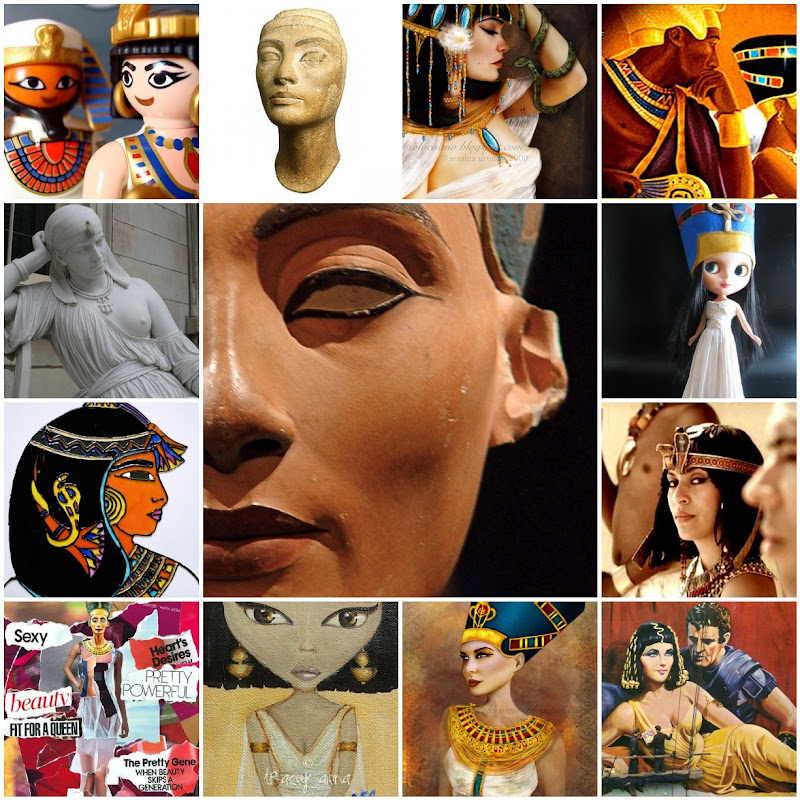
Inspired By Nefertiti and Cleopatra

Is it a coincidence that two of history’s most legendary beauties both came from Ancient Egypt? I think it’s fitting, since theirs was a culture that thrived on aesthetics, and considered even death to be a thing of beauty. The Ancient Egyptians were the first people to elevate writing, drawing and sculpture beyond essential trades to true art forms.

Nefertiti and Cleopatra Photo Collage

1. Nefertiti,
2. Cleopatra con el faraón, 3. Unfinished Head of Nefertiti, 4. Cleopatra, 5. Antigo Egito - Akhenaton e Nefertiti,
6. Cleopatra, 7. Queen Nefertiti, 8. Cleopatra, 9. Nefertiti Crown,
10. Nefertiti Model, 11. Cleopatra, 12. Nefertiti, 13. Cleopatra billboard


Nefertiti and Cleopatra have been the inspiration behind a great many works of art, films, books, fashions, and even jewelry. The use of color in Egyptian jewelry was not just for looks, but also for spiritual purposes. Gold was considered the flesh of the gods, and stones such as lapis and carnelian had their own special place in even the most mundane of objects. Here a just a few amazing handmade designs with the royal Egyptian flair:

Egyptian Inspired Handmade Jewelry

Cleopatra Lampwork Bracelet, If Cleopatra Lived in Texas, La Cleopatra Choker


It’s interesting that these two women would be the most recognizable Egyptian queens. They lived and ruled 1300 years apart, and were quite different in many ways. It would make more sense to compare Nefertiti to Hatshepsut - the first and longest reigning female pharaoh.


Cleopatra technically belongs among the likes of Helen of Troy, for she was actually of Greek descent. She was the last pharaoh of Egypt, ruling after the time of Alexander the Great. Though she came from Greece and associated with Romans, Cleopatra embraced the culture of Egypt, and was one of few royals to learn the language.


Nefertiti by ~LevinaTEG on deviantART


cleopatra by ~juliasan on deviantART


There were so many wonderful illustrations inspired by Nefertiti and Cleopatra, that I couldn’t possibly show them all here. You can see more favorites in a gallery of Nefertiti and Cleopatra deviations.

Which Egyptian queen is your favorite?

Copyright 2011 Inspirational Beading and Friends
Subscribe to Inspirational Beading


Tuesday, February 23, 2010

Basilisk Bracelet

Basilisk by kd matheson
Basilisk
Image Credit: kdm3000.

One of the most forgotten creatures of mythology is the fearsome and deadly basilisk. Known as the king of seprents, this creature has made appearances in many legends of ancient cultures, and has even been mentioned in the Bible. Although it's killing gaze and terribly potent venom were feared by many over the centuries, it rarely appears in modern fantasies - not nearly as often as dragons or unicorns.

The basilisk did make a brief return to the spotlight in J.K. Rowling's Harry Potter and the Chamber of Secrets, in which a giant snake terrorized Hogwarts School. In earlier legends, the basilisk had characteristics of both a snake and a rooster. It was the counterpart of the terrible cockatrice - a gruesome halfbreed with features of a cockerel and lizard.

The Inspiration:

The basilisk that I know best is the fantasy interpretation - a deadly blue-black snake that can kill with a single stare. Lately, my interest in strange and obscure creatures has been renewed after flipping through an old D&D Monstrous Manual in my weird and wonderful home library. I wanted to create a piece of jewelry to represent the mysterious and scaly basilisk, with it's hard skin and dark colors. Although it is one of the least pleasant monsters of mythology, I like a challenge of making something terrible look beautiful.

Dark Serpent Bead Palette

The Beads:

To mimic the shiny hardness of a magical snake's scales, I started with a mixture of dark metallic seed beads in 11/0 and 6/0. To these I added 8/0 seed beads in metallic hematite and matte gunmetal. The combination of colors and finishes created exactly the effect that I was looking for. Each one could represent a different side of an endless, slithering monster.

The Basilisk Bangle - The Sage's Cupboard

The Beadwork:

To achieve the look of many tiny scales, I used my bead selections to create a hollow right angle weave bangle. First, I created a long strip from the 11/o seed beads, with a single row of black 8/0's at the edge. When it was long enough, I stitched the ends together to form a loop, and added a few rows of the grayish matte gunmetal to either side of the ring. Once these were added, I pulled the edges together, and stitched them shut using the colored metallic 6/0 seed beads.

The larger beads along the middle of the bangle create a ripple effect. For this piece, I like the way it looks - there's no need for perfection when you're recreating a fearsome myth - and the changes in texture look more like a real serpent. If I were to make another bangle with this method, I would stick to two sizes of beads to make the beadwork smoother. I wasn't sure how much the beadwork would shrink once the edges were cinched together, so I cautiously made the first strip of beads quite long. I discovered that there is very little change once the bangle is assembled, so it is larger than most bracelets. I have declared this piece to be my first guy-friendly accessory.

Copyright 2010 Inspirational Beading


Sunday, February 7, 2010

Chimera Necklace

When Zeus banished the Titans to Tartarus in the Greek myth, the giants took their revenge by sending forth their monstrous children to terrorize the realm of the new gods. Gaia gave birth to the serpent Typhon, and though he would also be defeated by Zeus, he was able to wreak much havoc on the world, and sired three more terrible creatues: Cerberus, Hydra and Chimera.

These three-headed beasts are well known in Greek legends, and are still favorite monsters in many fantasy stories. The least well known is the Chimera, though it is arguably the most interesting of Typhon‘s children. With the heads of a dragon, a lion, and a goat, this monster is often depicted as female. In some versions of the legend, the Chimera was the mother of the Sphinx.

In modern art and stories, the anatomy of the Chimera has taken on many different forms. A Chimeric Creature is a blending of three monsters and animals, sometimes with multiple heads, and often bearing the wings and tail of a dragon.

The Inspiration:

Before I took up bead weaving, I collected vintage acrylic and lucite beads, and used them to create tapestries of bead strands to decorate my home. After many moves and encounters with kids, some of them are a bit disheveled. One that has survived completely intact is made entirely with red and black beads. It’s one of my favorites.

Like any decoration that hangs around for a long time, I had started to take my bead tapestries for granted. The red and black strands caught my attention one day, and I wanted to refresh my interest by making a piece of jewelry with the same elements. When I thought of the red and black together, I thought it would be fun to create a tribute to the mythical Chimera, using the traditional three headed version as inspiration.

Chimera Bead Palette

The Beads:

I started with three shades of 11/0 seed beads - light amber for the lion, Siam ruby for the dragon, and opaque black for the goat. For accents, I combined two mixtures of Fire Designs Furnace Glass beads - Queen of Hearts and Strawberry Shortcake. I selected my favorites in red, black and brown from this new mixture. I had a hard time choosing, and took a long while to create a balance between the single colored beads, and those with striped accents. I also added mixed strands of Czech fire polish beads in amber, jet and garnet, and a homemade mixture of hex cuts and Toho™ triangles in my Chimeric color palette.

Chimera Necklace Pendant Detail

The Beadwork:

I have always been a huge admirer of Margie Deeb’s Rainforest Cascade necklace, with it’s luscious strands of beads. I think most bead lovers can relate to the intense craving that thick strands of beads can induce. Although I love to look at them, I’m usually reluctant to use bare seed bead strands in my designs. My seed beads call out to be woven! So I sketched out a design that would have the same cascading feel that I liked, but used the tiny beads in a more structured way.

Chimera Beadwork Necklace - The Sage's Cupboard

To create a pendant, I used black hex cuts to make a tapered base, then added 17 strands of wide fringe. Each of the 17 strands ends with a cane glass bead, and has long fronds of seed beads ending with hex cuts or fire polish beads. To add some depth to the fringe, I mixed my original three seed bead colors with color-lined seed beads in dark amber brown, mauve and jet black. The lion colored fringe is at the center, so that the outer colors match up with the tubular peyote rope. I love the way the wide fringe has elements of both beadweaving and multi-strand, and the furnace glass adds just the right amount of texture. I almost don’t want to let this piece go!

I would like to thank Artbeads.com for providing the Fire Designs beads used in this piece. Inspirational Beading has not received paid compensation for including Artbeads.com products or reviews in this blog post. I have shared my honest opinions about the products used in this design.

Copyright 2010 Inspirational Beading


Tuesday, January 19, 2010

Helen of Troy Necklace

Helen of Troy - Anthony Frederick Sandys c.1867

Like most ancient tales, the story of Helen is never told the same way twice. The most common threads in the myth are that Helen was a daughter of Zeus, married to Menelaus, and the reason for the Trojan War. Some versions of the story are romantic; seduced by Paris, she flees with him to Troy to start a new and happy life. In other, darker stories, she follows Paris to Troy under the influence of the goddess Aphrodite, and eventually returns to Sparta with Menelaus after murdering her second Trojan husband, Deiphobus.

Whether she was a villain or a heroine, Helen of Troy is still known as a great beauty - the face that launched a thousand ships. As a queen of many countries, she would likely have owned some of the most wonderful treasures to compliment her legendary good looks.

The Inspiration:

When I learned that the theme for the January Etsy BeadWeavers challenge was the ocean, the first thing that came to mind was red coral. The material has been stirring up more controversy than usual of late. CITES - the organization responsible for the care and catalogue of endangered species - is considering adding red coral to the list of taboo creatures. This would essentially put an end to the use of red coral in art and jewelry.

For my challenge entry, I wanted to create a piece in tribute to the fight to save this amazing species. Coral of all kinds are so important to ocean habitat, and protecting them is a worthy cause. As I considered how to incorporate seed bead ‘coral’ into a piece of jewelry, I had thoughts of exotic, Mediterranean necklaces. I decided that I would create something worthy of a Greek queen.

Ancient Mediterranean Bead Palette

The Beads:

To represent red coral, I chose some ordinary opaque red 11/0 seed beads. To make the palette regal and luxurious, I added 8/0 seed beads and hex cuts in various jewel tones like sapphire and emerald. To add a touch of gold, I grabbed some sandy colored light amber seed beads. Although I was making a necklace for Helen of Troy, I also wanted it to look somewhat primitive - something you could find in a seaside stall in Ancient Greece. I hoped that this mixture would help create the rich elements of royal jewels, and the rustic look of archaic craftsmanship.

Helen's Treasure Necklace

The Beadwork:

I sketched out an arrowhead shaped pattern for a bib necklace, to which I would add fringes of red coral branches. After creating the sketch, I decided to add a freeform pattern within it - a line of loops and whorls for the jewel toned beads to follow. As I stitched the necklace, the changes in bead sizes caused the beadwork to take on a new shape which had the rustic look that I had hoped for.

Once the base of the necklace was complete, I added the coral branches. Although this had been my main focus, when I stepped back to look at the finished piece, I realized that it had been better without the fringe. I don’t think that the shapes or the colors compliment each other. If I were to do it over again, I would replace the amber beads with blue, and stitch a structured base to allow the fringe to play on it’s own.

In the end, I decided not to include “Helen’s Treasure” in the EBW Challenge. And, since I’ve been wanting a bib necklace for myself, I put it straight into my jewelry box!

Copyright 2010 Inspirational Beading


Blog Widget by LinkWithin
Fire Mountain Gems and Beads

Inspiration Topics

accessories amulet Ancient Worlds Modern Beads animals April's Army art ArtFire astrology astronomy autumn awards awareness bangle beach Bead Inspired Bead Shops bead soup bead spotlight bead stash Bead Trays beaded beads beading theory beads belt bezel birthstones black blog spotlight blue boho bone book spotlight bracelet Bracelet A Week branch fringe brick stitch brown bugles buttons cabochon ceramic chain maille challenge charity chevron chain christmas collar Collections color Color Ideas color triads conservation craft shows crafts crochet crystals cuff Culled Beads current events Current Faves daggers Daily Sets daisy chain Delicas Destash drops Dutch spiral earrings Egypt Egyptian Gods embellishing embroidery environment etsy exotic fair trade fantasy fashion Favorite Beads Favorite Techniques feminine fibers film findings fire polish fixtures Flashback Test flickr inspiration flowers food found object free form fringe Geek Jewels geekery gemstones geography giveaway glass gold gray Greece green herringbone hex cuts history holiday home decor insects inspiration tip inspired beader Inspired by... Inspiring Links ivory Jewelry Stash knitting ladder stitch lampwork lariat leaf fringe leather lights literature loomwork macrame magatamas Master Class Medallions metal free metalwork Mini Collar a Week mixed media mixture Mood Board MOP multi-color multi-strand music natural beads nature necklace Necklace a Day Nepal chain netting New Beads ocean ombre orange paint paper patterns pearls pendant peyote photography Picasso finish pink Pinspiration PMC polymer clay poster sketch purple quick inspiration rainbow RAW red resin ring Ring a Day rivoli Rome Russian spiral scarf science seed beads shell silver soutache spiral rope spring square stitch St. Petersburg steampunk stringing stripes summer tagua TBT The Elements thread Tilas Time Capsule tools trade beads triangle weave tribal tropical turquoise tutorial two-hole beads Ugly vintage Wear it Twice weather white winter WIP wire wishlist wood World Beaders yellow
Blog Home * About * Beading Tutorials * Advertise

Learn About Sponsoring Inspirational Beading with Project Wonderful
Affiliated With ShareASale.com and Amazon.com