Enter Beads for Brains: 365, a beading challenge inspired by Noah Scalin, the mastermind behind the Skull a Day project, and author of 365: Make Something Every Day and Change Your Life!
Friday, April 29, 2011
Blog Spotlight: Beads for Brains 365
Enter Beads for Brains: 365, a beading challenge inspired by Noah Scalin, the mastermind behind the Skull a Day project, and author of 365: Make Something Every Day and Change Your Life!
Tweet
Wednesday, April 27, 2011
Tribal Fringe Necklace
I found March’s new beads somewhat by accident, and although they aren’t trade beads, I couldn’t resist using them in a tribal design. I came across them while searching for some metal-free shank buttons for an upcoming PDF tutorial. I was thrilled when I found these adorable carved boxwood buttons with animal designs from Unique Buttons on ArtFire.
I was pleased not only with the design, but the price as well, so I kept looking around, and found the most amazing lizard button, which I’m sure will make an appearance in an upcoming challenge bracelet. Then I stumbled across a pair of horn shaped vintage Cherry Brand beads. They are so gorgeous, with beautiful yellow, white and brown stripes. I just had to scoop them up!
Then I had to choose a palette, and a technique for the necklace base. After going through my bead stash, making sketches, and imagining different approaches, I finally decided to make an eclectic charm necklace on a herringbone base. I was tempted to go with an ice cream palette, since the beads have a sort of banana-and-butterscotch-ripple thing going on. But it would be tricky to make it look elegant, and allow the beads to blend in to the design. Luckily, my need to use trade beads everywhere took over, and I came up with a wild and fun African-inspired palette instead. I included a single bead just larger than the horns as a focal piece, as much to keep them from clinking together as for looks.
This was one of the most difficult necklaces I’ve ever made. The techniques are simple, but I ended up using a size 13 needle for the entire rope section, and after a few days of work, I was afraid I had ruined my stitching arm. And here’s a handy tip: straight needles cannot pass through curved beads. Luckily, I have a packet of twisted wire needles, and they worked perfectly.
I actually completed this piece weeks ago, but I’ve been keeping it under wraps, waiting to see if it was chosen as a finalist in this year’s Bead Star competition. This is the first year that the contest has had a category for beadweaving, and I was very excited to enter something.
The Bead Star contest is hosted by Interweave Press and Beading Daily, with prizes provided by some incredible companies like Artbeads.com and Beadalon. There are categories for seed beads, crystals, metals and other materials, as well as a fun heart inspired category. There are some absolutely gorgeous designs to see and vote on this year. Best of luck to everyone who entered!
Meanwhile, I’m still on the hunt for exciting new beads. So far I’ve discovered some amazing new styles and shops, and I’ve got months to go. I have a feeling that I’ll want to keep up with this little tradition beyond 2011.
What new discoveries or experiments in beading have you made this year?
Copyright 2011 Inspirational Beading
Subscribe to Inspirational Beading
Tweet
Tuesday, April 26, 2011
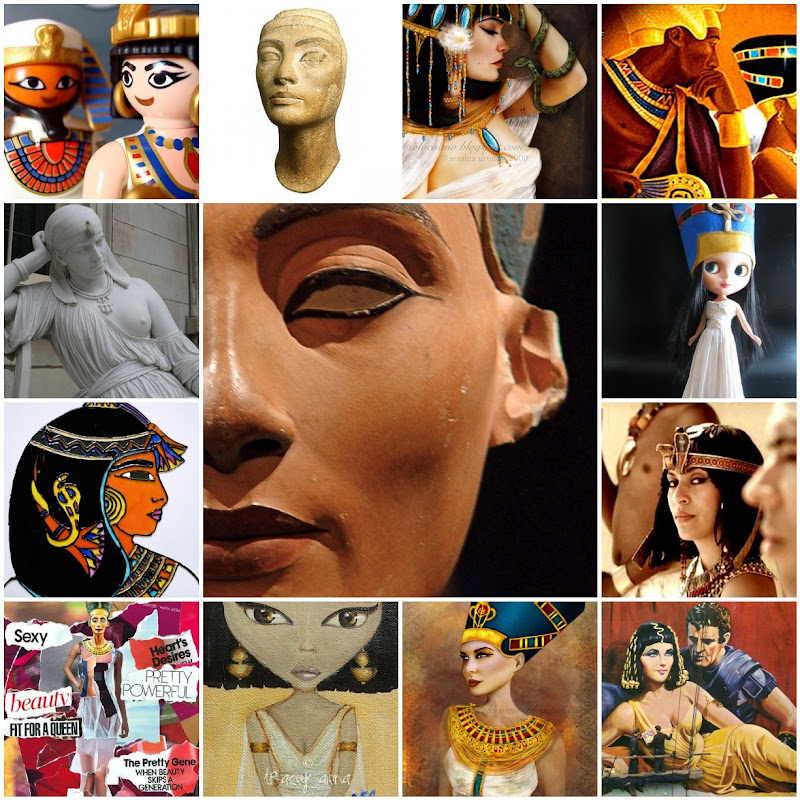
Inspired By Nefertiti and Cleopatra

1. Nefertiti,
2. Cleopatra con el faraón, 3. Unfinished Head of Nefertiti, 4. Cleopatra, 5. Antigo Egito - Akhenaton e Nefertiti,
6. Cleopatra, 7. Queen Nefertiti, 8. Cleopatra, 9. Nefertiti Crown,
10. Nefertiti Model, 11. Cleopatra, 12. Nefertiti, 13. Cleopatra billboard
Nefertiti and Cleopatra have been the inspiration behind a great many works of art, films, books, fashions, and even jewelry. The use of color in Egyptian jewelry was not just for looks, but also for spiritual purposes. Gold was considered the flesh of the gods, and stones such as lapis and carnelian had their own special place in even the most mundane of objects. Here a just a few amazing handmade designs with the royal Egyptian flair:

Cleopatra Lampwork Bracelet, If Cleopatra Lived in Texas, La Cleopatra Choker
It’s interesting that these two women would be the most recognizable Egyptian queens. They lived and ruled 1300 years apart, and were quite different in many ways. It would make more sense to compare Nefertiti to Hatshepsut - the first and longest reigning female pharaoh.
Cleopatra technically belongs among the likes of Helen of Troy, for she was actually of Greek descent. She was the last pharaoh of Egypt, ruling after the time of Alexander the Great. Though she came from Greece and associated with Romans, Cleopatra embraced the culture of Egypt, and was one of few royals to learn the language.
Nefertiti by ~LevinaTEG on deviantART
cleopatra by ~juliasan on deviantART
There were so many wonderful illustrations inspired by Nefertiti and Cleopatra, that I couldn’t possibly show them all here. You can see more favorites in a gallery of Nefertiti and Cleopatra deviations.
Which Egyptian queen is your favorite?
Copyright 2011 Inspirational Beading and Friends
Subscribe to Inspirational Beading
Tweet
Monday, April 25, 2011
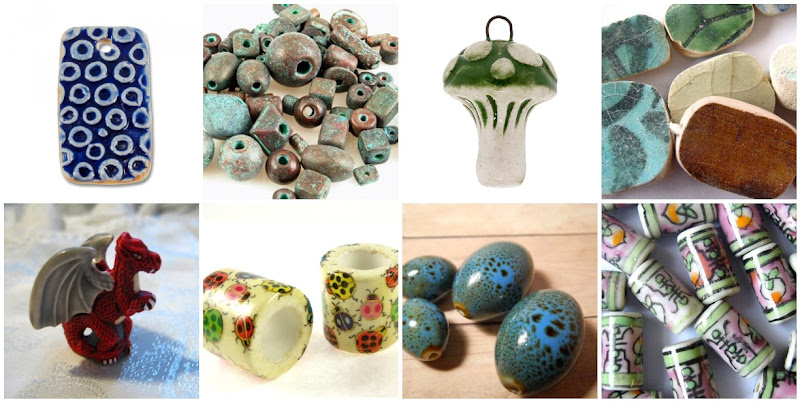
Bead Spotlight: Ceramic and Porcelain

Ceramic Rectangle Pendant, Greek Patinaed Bronze Ceramic Beads,
Earthenwood Studio Ceramic Toadstool Charm, Ancient Mosaic Tile Beads
Red Dragon Ceramic Bead, Vintage Ladybug Macrame Bead,
Speckled Oval Ceramic Beads, Chinese Painted Ceramic Beads
One of the most common materials used to make ceramics, pottery and porcelain is kaolin - a layered silicate mineral, also called white clay or china clay. The molded clay is hardened at extreme temperatures in a kiln, forming solid and beautiful pieces with delightfully earthy qualities. Glazes applied before the ceramic pieces are fired not only make them more durable, but add to their beauty as well.
Did you know? Kaolin comes from large mines all over the world, and is also a common ingredient for making glossy paper, toothpaste, incandescent light bulbs, paint and can be used as a pest deterrent in organic farming.

Ceramic Bead Bee Charm Bracelet, A Mix of Seasons Ceramic Necklace,
Ceramic Dragonfly Necklace, Red and White Sea Pottery Necklace
Straw Fields Pendant Necklace, Ceramic Bees with Gold Tone Earrings,
OOAK Ceramic Beaded Bracelet, Black and Red Ceramic Beaded Necklace
Do you like to use ceramics in your designs? What is your favorite style, shape or finish to work with?
Copyright 2011 Inspirational Beading and Friends
Subscribe to Inspirational Beading
Tweet
Saturday, April 23, 2011
A Bracelet a Week: Easter Eggs
This week, I wanted to experiment with a technique I haven’t used in ages - graduated tubular herringbone. The very first time I ever attempted it, I was limited to just three seed bead sizes, and it didn’t turn out as well as I had hoped. Now that my bead stash is a little more sophisticated, I thought it was time to revive the stitch and see what happened.
In order to get a really broad range of bead sizes, I wanted my base to be smaller than an 11/o, but 15/o seed beads seemed much too flimsy for the job of holding up bigger herringbone bobbles. So I went to delicas to start my palette, and chose a tube of lovely matte transparent grays.
The palette includes: 11/o wisteria lined crystal, 11/o opaque lustered turquoise, sapphire lined light sapphire Miyuki triangles, 8/o dichroic lined cornflower blue, 8/o fuchsia lined aqua, 6/o Czech ceylon pearl, 6/o Miyuki purple lined crystal AB, 4mm opaque gray lined cubes, and 4mm light jonquil lined aqua cubes. I later added some 8/o raspberry lined crystal beads as well.
It was so fun to have all of these beads laid out on my tray at one time, especially because I almost never get a chance to use delicas or cubes, and they all looked so pretty in their little cups and coasters. The bead tray I use is actually the lid of a veggies and dip container, and at about four bucks, it’s one of the best beading investments I’ve ever made. The round shape is especially handy for projects like this one, because I can place the beads along the outer edge, and rotate the tray for easy transitions.
I was a little worried halfway through the first increase that the bobbles would be too boxy thanks to the cubes at the center, but they rounded out again as the beads decreased, and I love the shape. Sizing was a bit of a hassle, and it took a lot of pondering to decide where to stop to get just the right length. Unfortunately, I wasn’t able to finish the pattern as smoothly as I would have liked, but I’m still happy with the bracelet overall. It actually turned out a lot more sophisticated than I had hoped it would.
Happy Easter!
Copyright 2011 Inspirational Beading
Subscribe to Inspirational Beading
Tweet
Inspiration Topics
Learn About Sponsoring Inspirational Beading with Project Wonderful
Affiliated With ShareASale.com and Amazon.com